

You had the bloodwork done. You were told everything looked normal.
But you are still waking up at night, feeling foggy, dealing with mood changes, noticing heavier or irregular periods, or wondering why your body suddenly feels different.
Normal labs can be useful information. They can rule out certain problems, point toward others, and help guide next steps. But one set of normal labs does not always explain what is happening during perimenopause.
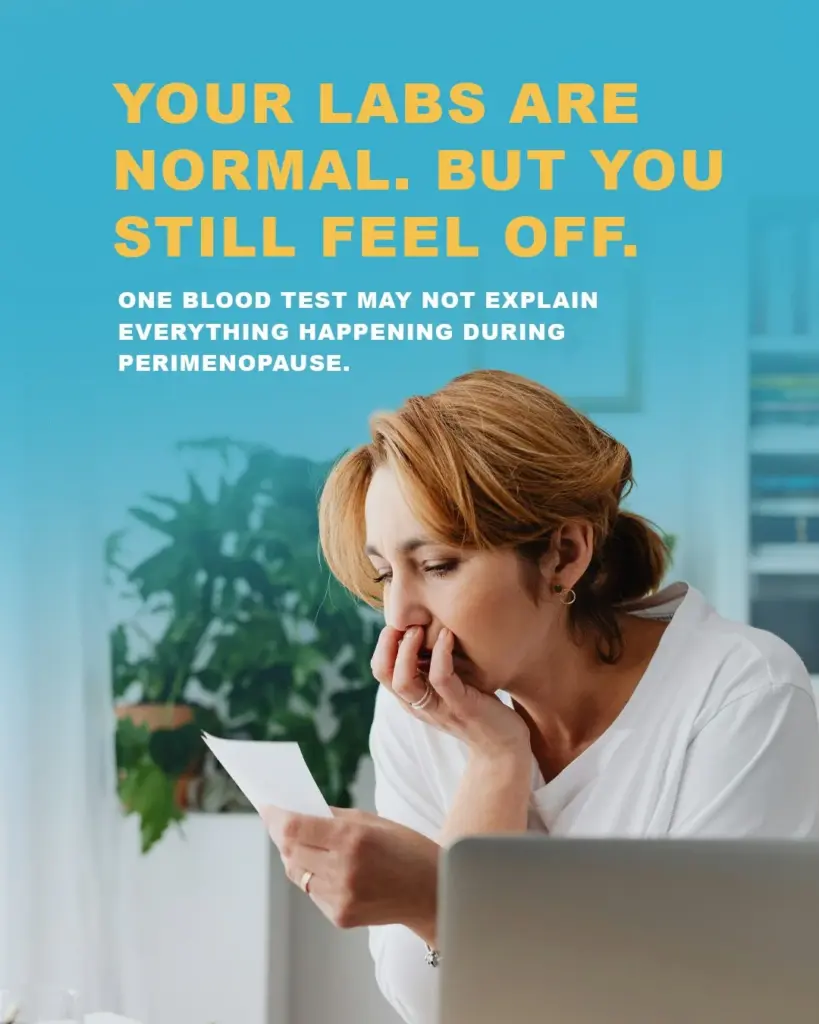
Yes, it is possible to have symptoms related to perimenopause even when your labs look normal.
That does not mean every symptom is hormonal. It means the full picture matters: your symptoms, your cycle pattern, your age, your medical history, your sleep, your stress load, your medications, your labs, and how these changes are affecting your life.
At Homesteady Health, this is the reason hormone care starts with evaluation. The goal is to understand what is actually happening before jumping to a treatment plan.
Why perimenopause can be hard to catch with one blood test
Perimenopause is the transition leading up to menopause. During this time, hormone levels can fluctuate. They may rise, fall, shift unpredictably, or look different depending on the timing of the test.
That is one reason a single lab result may not tell the whole story.
A woman can have symptoms for weeks or months, then have bloodwork done on a day when certain levels do not look unusual. That result may be real, but it may still be incomplete.
This is why symptoms and patterns matter.
Are My Symptoms Perimenopause, or Something Else?
What “normal labs” can and cannot tell you
Labs can be very helpful. They can help evaluate things like thyroid function, iron deficiency, metabolic markers, cardiovascular risk factors, and hormone levels when appropriate.
But labs are one piece of the evaluation.
They do not always answer questions like:
- Why am I waking up at 3am?
- Why do I feel foggy when I used to focus clearly?
- Why are my periods suddenly heavier or less predictable?
- Why do I feel more irritable or anxious than usual?
- Why does my body feel different even though I have not changed much?
- Why do I have symptoms even though I was told everything is fine?
Those questions need more than a quick glance at numbers.
They need a clinician to look at timing, symptoms, risk factors, medical history, medications, lifestyle factors, and what has changed from your normal baseline.
Symptoms that often get dismissed when labs are normal
Most women do not come in saying, “I think I need hormone therapy.” They come in saying something closer to:
“I do not feel like myself.”
That can mean different things for different people.
Common symptoms that may lead someone to ask about perimenopause include:
- waking up during the night
- night sweats
- hot flashes
- brain fog
- difficulty concentrating
- mood changes
- anxiety or irritability
- low libido
- vaginal dryness or painful sex
- persistent fatigue
- weight gain or loss of muscle tone
- irregular or heavy periods
The key point is that these symptoms deserve context. They should not be brushed off automatically because one lab panel looked normal.
Why “normal” does not always mean “nothing is wrong”
A lab result can be normal and still leave questions unanswered.
For example, a thyroid result may fall within a reference range, but the patient may still have symptoms that need more discussion. Hormone levels may not clearly show perimenopause on the day they are tested. Iron, sleep quality, blood sugar, medications, stress physiology, and other factors may also be involved.
The answer is not to assume hormones are the cause.
The answer is to avoid stopping too early.
A better evaluation asks:
- What symptoms are happening?
- When did they start?
- Are they getting worse?
- Do they follow a cycle pattern?
- Are periods changing?
- Is sleep changing?
- Are there hot flashes or night sweats?
- Are there vaginal or urinary symptoms?
- What labs have already been checked?
- What else could explain this?
- Is hormone therapy appropriate, or does something else need attention first?
That is the difference between being told “your labs are normal” and actually getting an explanation.
Perimenopause is often a pattern, not a single number
Perimenopause can show up gradually.
It may start with sleep changes before obvious hot flashes. It may start with heavier periods. It may show up as anxiety, irritability, lower stress tolerance, brain fog, or fatigue.
Some women still have regular periods during early perimenopause. Some have symptoms before they expect them. Some are told they are too young. Some are told to wait until periods stop.
That can leave people stuck.
If a woman is still cycling, still working, still managing daily life, and still technically “fine” on paper, her symptoms may be minimized.
But “fine on paper” does not always match the lived experience. A useful evaluation looks for patterns over time.
What else should be checked?
Perimenopause may be part of the picture. Other issues can also cause similar symptoms.
Depending on the person, a clinician may need to consider:
- thyroid concerns
- iron deficiency or anemia
- vitamin deficiencies
- poor sleep quality
- sleep apnea
- blood sugar changes
- medication effects
- anxiety or depression
- chronic stress
- cardiovascular risk factors
- gynecologic causes of heavy bleeding
- other medical conditions based on history
When does HRT enter the conversation?
Hormone replacement therapy may be appropriate for some women with perimenopause or menopause symptoms.
It depends on symptoms, medical history, risk factors, timing, goals, and whether the patient is a good candidate.
The Menopause Society’s 2022 position statement says hormone therapy remains the most effective treatment for vasomotor symptoms, such as hot flashes and night sweats, and genitourinary syndrome of menopause. It also emphasizes that risks can vary based on type, dose, duration, route, timing, and whether a progestogen is used.
That is why the decision should be individualized.
For someone with normal labs but significant symptoms, the next step is not automatically HRT. The next step is a better evaluation.
What to track before your appointment
If you are trying to figure out whether your symptoms could be related to perimenopause, track what is actually happening for a few weeks.
Helpful notes include:
- sleep changes, including waking during the night
- hot flashes or night sweats
- mood changes, anxiety, or irritability
- brain fog or focus issues
- period timing, flow, and changes
- vaginal dryness or painful sex
- libido changes
- fatigue
- weight or muscle changes
- medications and supplements
- prior lab results
- family history or personal risk factors
This gives your clinician a better starting point.
The goal is to identify a pattern, not to prove a diagnosis before your visit.
What a better hormone evaluation should look like
A strong hormone evaluation should include more than one lab result.
It should include:
- a detailed medical history
- symptom timeline
- period and cycle history
- review of prior labs
- discussion of risk factors
- medication review
- physical exam when appropriate
- lab work when appropriate
- discussion of hormone and non-hormone options
- a plan for follow-up
Homesteady’s women’s hormonal care program includes a one-hour consultation, detailed history, physical exam, lab draw, education about menopause and HRT, personalized treatment planning, and ongoing monitoring when appropriate.
Care is available for patients across New York State, with telehealth available statewide and in-person options available locally.
Labs can also be coordinated remotely when needed.
When to get evaluated
Consider scheduling an evaluation if symptoms are persistent, new for you, or affecting your sleep, work, relationships, mood, sexual health, or daily functioning.
Especially if you have already been told “everything is normal” and still do not have an explanation.
You do not need to wait until symptoms become severe.
You also do not need to know in advance whether this is perimenopause, menopause, thyroid-related, stress-related, metabolic, or something else.
That is what the evaluation is for.
Care is available by telehealth statewide, with in-person options available locally.
Start with a hormone evaluation and leave with a clearer plan.